
Cactus Identification Chart
Most cacti can be narrowed down to a group from just three features: the shape of the stem, what the spines (or lack of them) look like, and the flower colour. This identification chart uses those features to filter thirty common cacti, from giant saguaros to houseplant Christmas cacti, and explains how to check whether your plant is a cactus at all.
- Free to use
- No sign-up
- Runs in your browser
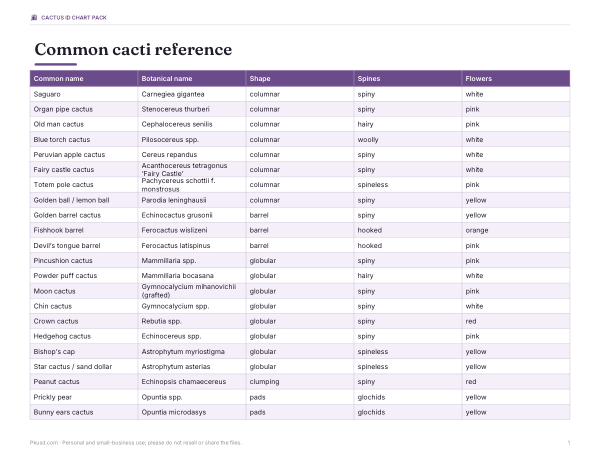
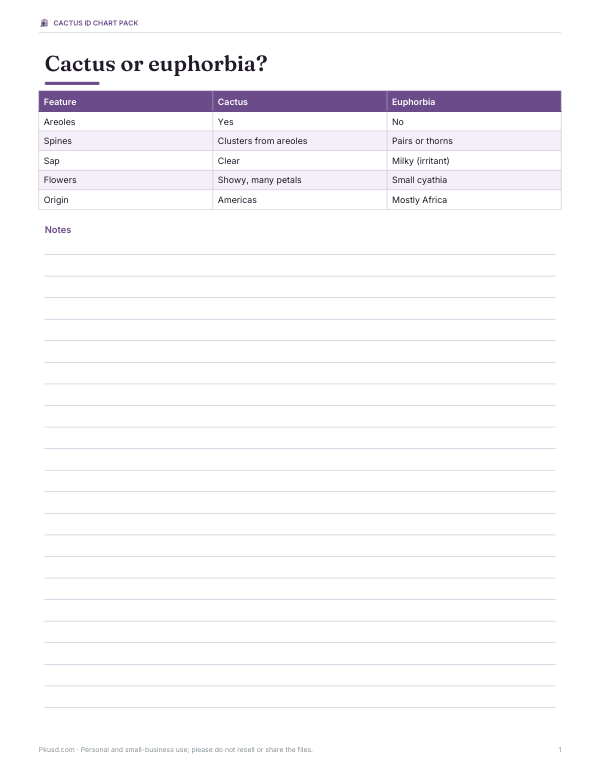
Quick answer
Cactus identification starts with confirming areoles: small cushion-like spots where spines, hairs, stems, or flowers emerge. Then match the plant’s stem shape, spine type, and flower color. Flat pads usually point to Opuntia, ribbed barrels to barrel cacti, nipple-like tubercles to Mammillaria, and flat leaf-like segments to forest cacti such as Christmas cactus.
Cactus identification key
Cactus ID Chart Pack
Printable cactus identification charts: shape and spine key, 30-cactus reference table, cactus vs euphorbia card and a collection log for your plants.
- Reference chart (PDF/XLSX)
- Look-alike card (PDF)
- Collection log (PDF/DOCX/XLSX)
Formats: PDF, XLSX, DOCX. Instant download after payment (link valid 72 hours, up to 5 downloads). AI-assisted: the templates were drafted with AI help and reviewed and laid out before publishing.
$5.00 USD, one-time 3 files · about $1.67 each
- Instant download
- 7-day refund
- Secure checkout by Stripe
7-day money-back guarantee. Full refund within 7 days of purchase, even after you download.
Full refund within 7 days — see the refund policy and license.
Free printables
Single sheets you can print right now, no sign-up. The full pack adds every sheet in one download plus the editable files.
Quick cactus identification clues
Use these common visual clues to narrow down what kind of cactus you have.
| Cactus or group | Stem shape | Spines | Flower clue |
|---|---|---|---|
| Saguaro | Tall column | Straight | White |
| Golden barrel | Round, ribbed | Golden straight | Yellow |
| Fishhook barrel | Round, ribbed | Hooked central | Yellow to orange |
| Mammillaria | Small balls | Straight or hooked | Ring near top |
| Prickly pear | Flat pads | Glochids | Yellow, orange, red |
| Bunny ears | Flat pads | Glochids only | Yellow |
| Cholla | Jointed cylinders | Glochids, spines | Varies |
| Old man cactus | Tall column | Long white hair | Red or pink |
| Christmas cactus | Flat segments | No real spines | Pink, red, white |
| Orchid cactus | Flat trailing stems | Few or none | Large, showy |
| Rat tail cactus | Thin trailing stems | Short bristles | Pink to red |
| Dragon fruit | Climbing 3-angled | Few spines | Large white |
Is it a cactus? Look for areoles
Every cactus has areoles — small cushion-like spots, often woolly, from which spines, new stems and flowers grow. Areoles are the defining feature of the cactus family (Cactaceae). Many succulents look like cacti but lack them. Spineless cacti such as Christmas cactus and bishop’s cap still have areoles, sometimes just as tiny dots or felt patches.
| Feature | Cactus | Euphorbia (look-alike) |
|---|---|---|
| Areoles | Yes | No |
| Spines | Grow in clusters from areoles | Usually in pairs, or thorns from the stem |
| Sap | Clear (usually) | Milky white latex — an irritant, keep away from eyes and skin |
| Flowers | Often large and showy with many petals | Small, cup-like (cyathia) |
| Origin | Almost all from the Americas | Mostly Africa and Madagascar |
African milk tree (Euphorbia trigona), pencil cactus (Euphorbia tirucalli) and baseball plant (Euphorbia obesa) are all euphorbias, not cacti, despite their names and looks.
Stem shapes
| Shape | Examples |
|---|---|
| Columnar | Saguaro, organ pipe, old man cactus, blue torch, Peruvian apple |
| Barrel | Golden barrel, fishhook barrel, devil’s tongue |
| Globular | Pincushion (Mammillaria), chin cactus, crown cactus, star cactus |
| Flat pads | Prickly pear, bunny ears |
| Jointed cylinders | Cholla, teddy bear cholla |
| Leaf-like segments | Christmas, Easter and orchid cacti (forest cacti) |
| Trailing / climbing | Rat tail, mistletoe cactus, dragon fruit |
Ribs or tubercles?
Look closely at the surface. Ribs are continuous vertical ridges, with areoles along their edges — typical of barrels and columns. Tubercles are separate nipple-like bumps, each topped by an areole, arranged in spirals — the hallmark of Mammillaria (pincushion cacti). Some cacti, like the chin cactus, have ribs broken into lumps. Counting ribs can help: bishop’s cap usually has five, the star cactus about eight, golden barrels twenty or more.
Spines, glochids and hair
- Straight spines — most cacti; radial spines spread around the areole and one or more central spines stick out.
- Hooked spines — a curved tip on the central spine, as in fishhook barrels and many Mammillaria.
- Glochids — tiny, barbed bristles in tufts, found in Opuntia and cholla. They detach easily and are hard to remove; use tape or tweezers, not fingers.
- Hair — long white hair-like spines, as in old man and powder puff cacti, which shade the stem.
- Spineless — forest cacti and some desert species have tiny or no spines.
Forest cacti vs desert cacti
Not all cacti live in deserts. Christmas cactus, Easter cactus, orchid cactus, rat tail and mistletoe cactus are epiphytes from tropical and subtropical forests, where they grow on trees. They have flat or thin stems, few or no spines, and prefer bright indirect light, more water and humidity than desert cacti. Mistletoe cactus (Rhipsalis baccifera) is the only cactus thought to occur naturally outside the Americas, in Africa and Sri Lanka.
Worked example
A houseplant has flat, bright green, jointed segments with small teeth along the edges, no spines and pink flowers in December. Choosing “Flat leaf-like segments” and “No real spines” narrows the key to Christmas cactus, Easter cactus and orchid cactus. The timing and pointed teeth point to a Christmas or Thanksgiving cactus (Schlumbergera); rounded segment edges and spring flowering would suggest an Easter cactus instead.
Flowers as clues
Cactus flowers are short-lived but distinctive. Many columnar cacti flower at night and are pollinated by bats and moths (white flowers). Mammillaria flowers appear in a ring near the top, while Rebutia flowers sprout from the sides and base. Hedgehog cacti have green stigma lobes in the centre of the flower. Record the colour, position and time of year with a photo — it helps with a precise identification.
Getting a confident ID
- Photograph the whole plant, a close-up of the areoles and spines, and any flowers or fruit.
- Note the growth habit: solitary or clustering, upright or sprawling.
- Record where it grows (outdoors in which region, or as a houseplant).
- Ask a local cactus and succulent society or botanic garden — many run identification help.
- Plant labels in garden centres are sometimes wrong, especially for common names.
Some cacti are protected by law in the wild, and international trade in many species is regulated under CITES. Never dig cacti from the wild; buy nursery-grown plants.
Caring for the cacti you identify
| Group | Light | Water | Winter |
|---|---|---|---|
| Desert columnar and barrel cacti | Full sun or very bright light | Soak and let dry completely | Keep cool and dry to encourage flowering |
| Globular cacti (Mammillaria, Rebutia) | Bright light, some direct sun | Soak and dry; less in winter | Cool, dry rest helps them flower |
| Opuntia and cholla | Full sun | Sparingly | Many are frost-hardy when dry |
| Forest cacti (Christmas, Easter, orchid) | Bright indirect light | Keep lightly moist in growth | Cooler nights and shorter days trigger buds |
Identifying the group is often enough to care for a plant well: overwatering desert cacti and underwatering forest cacti are the two most common mistakes. Use a free-draining gritty mix and pots with drainage holes for all cacti.
Limits of this key
There are around 1,500–1,800 cactus species. This key covers thirty common cacti seen in gardens, deserts of the American Southwest and houseplant collections, and identifies most to genus level. Hybrids, cultivars and young plants may not look like the descriptions.
Frequently asked questions
What cactus do I have?
Look first for areoles to confirm it is a cactus, then compare the stem shape, spine type, and flower color. A close photo of the areoles and the whole plant usually gives the best match.
What cactus is this if it has flat pads?
A cactus with flat paddle-like pads is usually an Opuntia, such as prickly pear or bunny ears. Check for tiny barbed glochids, which are common in this group.
Can I identify a cactus species from a photo?
Often you can narrow it to a genus or common type from photos, but exact species can be difficult without flowers, fruit, size, and origin. Include a whole-plant photo plus close-ups of spines and areoles.
How do I identify my cactus?
Start with stem shape, spine type and flower colour, then compare details such as ribs or tubercles and areoles.
What is an areole?
A small cushion on a cactus from which spines, flowers and new growth emerge — every cactus has them.
Is a pencil cactus a real cactus?
No. It is Euphorbia tirucalli, a succulent with irritant milky sap.
What cactus has flat pads?
Prickly pears and bunny ears (Opuntia).
What is the cactus with long white hair?
Usually the old man cactus (Cephalocereus senilis), or powder puff (Mammillaria bocasana) if small and round.
Are there cacti without spines?
Yes — Christmas cactus, bishop’s cap, star cactus and mistletoe cactus, among others.